Showing posts with label healthy food access. Show all posts

Wednesday, July 1, 2026

How Data Sparks Conversations About Health and Equity in the Bronx


The following post features Bronx Health REACH Project Director Charmaine Ruddock and was written by County Health Rankings & Roadmaps (CHR&R), a program of the University of Wisconsin Population Health Institute and can be found at their website. 


For over two decades, Bronx Health REACH (BHR) has been a force for health equity in New York City’s most under-resourced borough. Led by the Institute for Family Health, this coalition of more than 80 organizations has worked to eliminate racial and ethnic health disparities in the Bronx. One of their most powerful tools? County Health Rankings & Roadmaps (CHR&R) data-informed Health Groups (formerly known as Rankings).


Health Groups illustrate the relative similarities in county health among Health Groups on a national scale. Health Groups support data-informed comparisons in county community conditions, as well as population health and well-being on a national scale. When CHR&R previously used ordinal rankings to order each county in a state from most to least healthy, Bronx County consistently ranked 62nd out of 62 counties in New York State — a stark reminder of the deep-rooted inequities facing the community.


In 2015, Bronx Health REACH and several key stakeholders in the Bronx launched #Not62: The Campaign for a Healthy Bronx, using CHR&R data as a rallying cry. “We’ve used the Rankings as a critical way to talk about it,” said Charmaine Ruddock, BHR’s project director. “This should be unacceptable.’”


This simple but powerful message has helped Bronx Health REACH “needle” policymakers—their word for persistent, strategic advocacy. “Others call it advocacy; we call it needling,” Ruddock explained. “To be incessant and insistent. To prod those who need to be prodded.”


CHR&R data have also helped the coalition educate the public. Many Bronx residents didn’t know their county’s health relative to others in the state. “It gave us a clear, easy-to-understand way to talk about the health of our community,” Ruddock said. “It helped us say, ‘Here’s where we are. Here’s what needs to change.’”


In 2021, Bronx Health REACH hosted a community event with CHR&R staff to celebrate improvements in some health behaviors and community conditions. “We were able to show where we moved from 50-something to 20-something in certain measures,” Ruddock said. “That was because of our efforts and partners’ efforts. The Rankings helped us tell that story.”


As CHR&R has shifted from ordinal rankings to data-informed Health Groups, Bronx Health REACH continues to use the data to push for change. “With the Health Groups, we see the opportunity to connect with other communities across the country who are in similar health groups. That opens the door for a national conversation.” In June 2025 Bronx Health REACH — partnering with the steering committee of the Not62: A Campaign for a Healthy Bronx, the National REACH Coalition and CHR&R — convened a meeting with organizations from communities in eight states, who shared similar challenging health outcomes and the determining community conditions.  The goal of the meeting was to address these outcomes and to explore the possibility of joint efforts.  


CHR&R has also helped Bronx Health REACH build credibility with funders, health systems and elected officials. “CHR&R comes with such authority,” Ruddock said. “When we use CHR&R data, it validates what we’re saying. It gives weight to our demands.”

Friday, December 19, 2025

PS 32’s Open Streets: Building Relationships and Growing Capacity


 This blog post was written by Maurelhena Walles, Founder and CEO of Equity Design and Diana Bernal, Program Coordinator for the Creating Healthy Schools & Communities program at Bronx Health REACH.


Three years ago, the principal and staff of PS 32 located in the Bronx, expressed a far-reaching vision of becoming their community’s fitness hub. As part of the New York State Creating Healthy Schools and Communities (CHSC) program, PS 32 teamed up with Bronx Health REACH, Equity Design, and Street Lab to make this vision happen. The first step Equity Design, whose role was facilitator, took, with the permission of PS 32’s Principal Rebecca Lew, was to gather together the school teachers and staff to assess the challenges and aspirations for improving the physical and social well-being of the school. As a result, they decided to implement Open Streets, a program that temporarily closes down a street to cars during the day to provide open space for people to gather and play. 


To successfully implement Open Streets at PS 32 every school year, teachers and school staff held team building and mind-mapping sessions to get to know each other better. Through these relationship building exercises, their school wellness council was formed. As PS 32’s school wellness council grew, so did the ideas for Open Streets events, and how to utilize them for more than just physical activity for the students. PS 32 came up with their Outdoor Learning initiative, which aimed to provide a blend of academics and physical activity. Through this initiative, the school has connected with their surrounding community and built relationships with community residents and nearby organizations. An example of an event that came together through these partnerships is PS 32’s Hispanic Heritage Month event. This event combined physical activity and academics through dancing and interactive activities centered around the cultures from different Latin/Hispanic countries. One of the teachers involved in planning the event connected the school with her church’s dance group, who performed a folkloric dance, showcasing what can be accomplished when relationships are built between a neighborhood and school community. 


Through this process of relationship building, PS 32 has brought together teachers, students, and the neighborhood community to participate in physical activity. Another collaboration coming out of Equity Design’s team building session was connecting PS 32 and Fordham University’s athletics department. The outcome of this is Fordham students volunteering at PS 32’s Open Streets events. By taking the time to build relationships, PS 32’s Open Streets program has gone from happening 3-6 times a year to now occuring once a week. 

Monday, September 8, 2025

Bronx Health REACH Calls for MTA to Reinstate Alcohol Ad Ban


Photo above from October 20217. 


In 2017 the NYC MTA voted to ban alcohol ads on subways, buses and trains, a result of a city wide grassroots campaign of Building Alcohol Ad-Free Transit (BAAFT) and Bronx Health REACH coalition members who gathered petition signatures, held rallies, and provided testimonies at various MTA public hearings prior to the Board's voting. But this was recently reversed by the MTA board. Citing a $7 million annual loss in revenue attributed to the ban, the Board voted to bring the alcohol ads back. In response to this vote, Bronx Health REACH, Interfaith Public Health Network and other medical and faith leaders held a rally about the public health risks of alcohol marketing on public transit, particularly its impact on youth, people in recovery, and communities of color, and called for the MTA board to reinstate its 2017 ban on alcohol advertising across subways, buses, and train stations.


"BHR was proud to have been part of the grassroots effort that successfully advocated with the MTA to ban alcohol advertising from its transit system several years ago. It was true then and is true now, that alcohol advertisers specifically target susceptible communities like the Bronx. That MTA win meant one less battle for the Bronx and similar communities in the fight for a healthy environment. We cannot go back," said Charmaine Ruddock in a press release prior to the MTA's vote to reverse the ban.


Fox5 NY spoke with BHR's Charmaine Ruddock about the MTA reversing the ban. 

Monday, September 1, 2025

9 Bronx Bodegas Sell Healthy, Affordable Snacks as Part of a Healthy Bodega Pilot


 Nine Bronx bodegas have been selling healthy, delicious snacks as part of the Healthy Bodega pilot. 


Nine Bronx bodegas have been selling Healthy Bodega/Bodega Fresca, a line of healthy, delicious and affordable Latin-Caribbean-inspired Grab-and-Go meals, as part of a Healthy Bodega pilot. Bronx Health REACH received funding from the New York Health Foundation to collaborate with Bodega and Small Business Group (BSBG), Collective Fare, Shen’naque Sean Butler of FRESCH, and others to pilot a sustainable business model for bodegas to sell healthy, culturally relevant grab-and-go items, in the Hunts Point section of the Bronx.


The pilot builds on BHR's more than two decades of grassroots food justice advocacy in the South Bronx to encourage bodegas to sell healthier food. Over the last decade, collaborating with the Bodega and Small Business Group (the bodega trade association), and, more recently with the FRESCH Initiative, founded and led by Shen’naque Sean Butler, and NYU's Stern School of Business, we have worked to identify and address the barriers bodegas face to selling healthy food. With this current effort, involving the creation of eight healthy food offerings by Collective Fare, customer and store-owner feedback was solicited and confirmed that these products are not just welcomed but highly desired, reinforcing the need for healthier, more affordable options in local bodegas. 


 A media event was held in May with Bronx Borough President Vanessa L Gibson, Bronx Health REACH/The Institute for Family Health, Francisco Marte (President of the Bodega and Small Business Group/BSBG), LaToya Meaders (CEO of Collective Fare Kitchen and Market), and Shen’naque Sean Butler (Founder of FRESCH Initiative) attending. 


Click to view News12 The Bronx story about the launch.

Friday, February 28, 2025

Black History Month: Creating Healthy Food Environments in the Bronx


Shen’naque Sean Butler and Francisco Marte, Founder of Bodega and Small Business Group


This article was written by Kelly Moltzen, Program Manager at Bronx Health REACH, Charmaine Ruddock, Project Director at Bronx Health REACH, and Bronx Health REACH Coalition member Shen’naque Sean Butler.


African Americans have faced injustices in the food system ever since the days of enslavement, when Africans brought to America lost the food sovereignty they had in their native lands, and as slaves, were forced to subsist on meager food rations of poor dietary quality such as pig intestines, lard and cornmeal. But resistance to these injustices has existed for just as long, with enslaved people cultivating crops from Africa such as okra, yams, black-eyed peas, and creating dishes using ingredients that were native to Africa when they could.

Fannie Lou Hamer’s founding of the Freedom Farm Cooperative in 1967 as a rural economic development and political organizing project was a later action in the Black food justice movement. The Freedom Farm Cooperative sought to uplift Black families through food provisions, such as vegetable gardens and pig-raising, and through community support for housing development and education. By providing food and financial services, the Cooperative allowed Black families to be self-sufficient. This Cooperative is seen by many as a foundation for the modern food security and food justice movements.

In the Bronx, a leader that continued this fight for food justice is Karen Washington, a Black urban farmer, and co-founder of the Black Farmer Fund. A James Beard 2014 Leadership Award Honoree, she worked to dismantle what she so aptly termed “food apartheid” in Black communities.

Recognizing the historical injustices and the power of grassroots community advocacy to address those injustices, Bronx Health REACH, since its inception, has been working with community partners to advance food justice. This has been done through efforts such as encouraging policy makers and elected officials to increase access to affordable fresh produce at farmers markets, promoting farmers and farmers markets to community members, and supporting faith-based organizations’ establishment of gardens.

For more than a decade, Bronx Health REACH has been involved in supporting local business owners selling healthy food, collaborating with the Bodega and Small Business Group (BSBG) to train bodega owners to sell healthier food, and promoting those healthier options through the creation of the “Don’t Stress, Eat Fresh” consumer campaign. In 2019, Bronx Health REACH supported Bronx community member and food justice advocate Shen’naque Sean Butler to implement his vision for a healthy bodega initiative.

Shen’naque Sean Butler’s family migrated from Savannah, Georgia, to New York during the Great Migration, seeking economic opportunities and escaping racial violence. Unfortunately, the racial injustices they sought to escape followed them in one form or the other, one of which was redlining—a government policy that systematically removed resources from Black communities. Redlining has had a lasting impact, contributing to the creation of food deserts in areas like the Bronx, where access to fresh and affordable food is severely limited.


As a descendant of American chattel slavery, Shen’naque Sean Butler carries not only the legacy of pain but also the resilience of his ancestors. In 2019, inspired by his late mother, Jocelyn Butler, Shen’naque founded FRESCH (Food Revolution Empowering Sustainable Community Health), to address food insecurity and promote healthier eating habits in the Bronx by connecting local food systems. He implemented a pilot group purchasing model where healthy grab-and-go food items were sold at bodegas for customers to purchase at affordable prices. This initiative included bodegas both within and outside the BSBG network.

The initiative delivers plant-based meals to local bodegas, providing nutritious options in areas where fresh food is scarce. FRESCH also hosts workshops and seminars to educate the community about healthy eating and advocates for policy changes to improve food transparency and marketing practices.

In 2024, building on FRESCH and the previous work with BSBG, Bronx Health REACH received funding from the New York Health Foundation to collaborate with BSBG, Collective Fare, Shen’naque Sean Butler, and others to pilot a sustainable business model for bodegas to sell healthy, culturally relevant grab-and-go items, in the Hunts Point section of the Bronx.

The effort to establish a healthy food retail environment with culturally relevant, affordable options for communities of color has continued, gaining momentum to counter the injustices that have gotten worse in the food system over the past several decades. Dr. Marcia Chatelain, a professor of African American history and author of the book, Franchise: The Golden Arches in Black America explains an association between the food retail environment and being “Black.” Dr. Chatelain points out that in the 1960’s, the federal government, through a series of efforts, encouraged the creation of Black businesses as an opportunity to build wealth and create badly needed jobs.  During this time, the fast food industry lobbied government and convinced civil rights organizations that fast food franchising could be good for building Black wealth. Yet, the low-wage jobs created through the franchising model, coupled with the creation of unhealthy food environments in Black communities, turned out to have detrimental economic and health consequences in these communities. Exacerbating the problem was the practice of many food companies associating Black culture with their industrialized food through targeted predatory marketing of fast food and other unhealthy food products. This has had disastrous effects on the health of consumers, with disproportionate impacts especially seen in Black communities.

Despite all of this, the movement that has long embraced the narrative of cultural pride focused on an entrepreneurial model of building Black owned food businesses promoting healthy food, establishing a new cadre of Black farmers, and farmers markets, and securing new retail outlets for those foods continues. The goal of such a movement is still to improve the health and lives of Black communities.

Wednesday, November 6, 2024

New York City Department of Health and Mental Hygiene Recognize BHR Community Health Workers

Left to right: Cheikhou Oumar Ann, Felix Rojas, and Joseph Ellis. 

On Saturday, October 14, Cheikhou Oumar Ann, Felix Rojas and Joseph Ellis, Community Health Workers with the Institute for Family Health’s Bronx Health REACH (BHR), were recognized at a ceremony hosted by the New York City Department of Health and Mental Hygiene (NYCDOHMH) for their outreach work with men in the community. The award was for their outstanding work during NYCDOHMH’s Harlem Family Wellness Suite Day for Dads’ event in June; and for their leadership of the Men, Let’s Talk initiative.

Since 2020, they have led Men, Let’s Talk, a monthly forum for Black and Latino men to engage in open and honest discussions about their mental health concerns. Cheikhou, Felix and Joseph have also served as the Community Outreach and Engagement Team for the CDC Covid and Flu initiative through which more than 12,000 vaccines have been administered to Bronx community residents. They also lead the Immigrant Health initiative, providing information to community members who are new immigrants in the Bronx, and referring those who need healthcare to the Institute’s health centers.

Thursday, February 1, 2024

Food as Medicine: A “Prescription” for Fresh Fruit and Vegetables


This article was written by Kenny Escobar, Nutrition & Physical Activity Coordinator, Jamila Outlar, Produce Prescription Coordinator, and Intern Stephanie Garcia.

In the winter of 2023, Bronx Health REACH and Corbin Hill Food Project Inc. (CHFP) launched the Food as Medicine Produce Prescription Program (FAM) for patients at three Bronx-based Institute for Family Health (IFH) centers to promote the consumption of healthy food.

The FAM project is funded by the Gus Schumacher Nutrition Incentive Program (GusNIP) grant from the National Institute of Food and Agriculture (NIFA) of the USDA.  Project participants must be an IFH patient over 18 years of age and screen positive for food insecurity. Once enrolled, participants receive a box of high quality, fresh local fruits and vegetables on a bi-weekly basis for a minimum of six months. The average price for the box of produce is roughly $35 but through FAM the cost to patients is only $2.50. The participants can pay with SNAP, cash, debit, or credit card. Participants who have SNAP can also pay with Health Bucks.

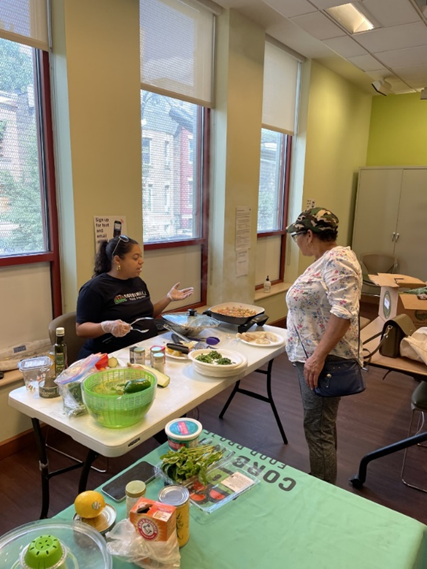
The FAM project also provides participants with recipes at each distribution in order to encourage the eating of fruits and vegetables. These recipes include creative and helpful ways to use the produce from that week’s distribution. Food demonstrations accompany the distribution of the recipes at least once a month at each health center introducing participants to  fruits and vegetables they may not have known or previously eaten. 


Chef Yadi leading a food demonstration. 

Bronx native Chef Yadira Garcia, also known as, the “Happy Healthy Latina” or Chef Yadi, is the chef enthusiastically creating delicious and nutritious dishes for patients to try. She makes sure that patients are educated on the multiple ways to prepare the different produce and is always open to answering any questions that the participants may have. 


As of February 2024, when enrollment ended, 374 patients were enrolled in the program and 130 have completed their 6-month commitment. We will conduct a program evaluation to assess patients’ overall opinions and feedback of the program to determine the effectiveness of this intervention and the impact it has had on the participants. To date feedback from some participants indicate that the program, for them, is a resounding success. An Urban Horizons patient shared that they are “very happy as a lot of us need this program, we get healthy food and we need this in the neighborhood. You’re doing a very good thing for us." A Stevenson patient said she “enjoys this program so much as I am learning how to cook and eat different things.” A patient from Walton stated, “by receiving these produce box two times a month, I am able to eat healthier which is contributing to my weight loss.”


Friday, September 8, 2023

Join us this FRIDAY SEPT 15 for Racism and Our Families’ Health: Connecting the Dots…Why the Conversation Matters from 10AM to 12PM


Join us this FRIDAY SEPT 15 for Racism and Our Families’ Health: Connecting the Dots…Why the Conversation Matters from 10AM to 12PM. The presentations and discussions will offer lessons in how to effectively respond to our most pressing social issues employing a lens of anti-racism. 


Questions? imoronta@institute.org.


Click here to view Part 1 of a recent discussion with Stay Alive with Church Alive (hosted by Bishop Timothy Birkett) featuring Immaculada Moronta from The Institute for Family Health/Bronx Health REACH, Rev. Dr. Calvin R. Kendrick, Pastor of Grace Baptist Church in the Bronx, and Father David Powers from RC St. Helena Church as they discuss the Racism and Our Families Health series of webinars as they discuss: What is racism? What are the types of racism? Where do we find racism? Why does the conversation about race matters to all?


Click here to view Part 2 of a recent discussion with Stay Alive with Church Alive (hosted by Bishop Timothy Birkett) featuring Immaculada Moronta from The Institute for Family Health/Bronx Health REACH, Rev. Dr. Calvin R. Kendrick, Pastor of Grace Baptist Church in the Bronx, and Father David Powers from RC St. Helena Church as they discuss the Racism and Our Families Health series of webinars as they discuss the following: How is racism making us sick? How is racism affecting our wellbeing? How do you achieve equity goals as an organization and/or individuals?

Join Us 9/14 for The Bronx Responds:  One Year After the White House Conference on Hunger, Nutrition and Health from Local to National Policies and Back


You are invited to join us on Thursday, September 14th (9 a.m. to 4:30 p.m.) for a virtual conference with thought provoking and action oriented discussions about food and nutrition-related work happening in the Bronx and the policy implications of this work.  In 2022, the White House held the first Conference on Hunger, Nutrition and Health in over 50 years and as an outcome, earlier this year, a National Strategy on Hunger, Nutrition and Health was released.  The priorities of our national government and policymakers have implications for food access, affordability, and nutrition education in the Bronx and similar communities impacted by diet-related health disparities.


Topics include:

• Nutrition and Health Equity in the Bronx 

• Overview of the Farm Bill and Its Effects on Local Communities  

• Improving Food Access in Community Settings 

• Integrating Nutrition and Healthcare: Food as Medicine and Food insecurity screenings 

• Knowing What’s in Your Food: Bringing Nutrition Education to the Community

• Eating Soulfully 

• Reimagining your Local Bodega with Better Food 

• Envisioning the Food System of the Future 


Click Here to Register.

After registering, you will receive a confirmation email containing information about joining the meeting via Zoom.

Speakers include:

Bronx Borough President Vanessa L. Gibson

Christina Badaracco,  Healthcare Consultant, Registered Dietitian, and Co-Author of The Farm Bill: A Citizens’ Guide

Dr. Jen Cadenhead, Executive Director, Teachers College Laurie M. Tisch Center for Food, Education and Policy  

Rev. Dr. Christopher Carter, Author of The Spirit of Soul Food: Race, Faith, & Food Justice 

Ribka Getachew, Director of the NY Good Food Purchasing Program Campaign, Community Food Advocates 

Norma Gonzalez, Farm Share Manager, Corbin Hill Food Project 

Theresa Landau, Program Director, Morrisania WIC

Francisco Marte, President, Bodega and Small Business Group 

LaToya Meaders, Co-Founder and CEO, Collective Fare 

Dr. DeAnna Nara, Senior Policy Associate, Center for Science in the Public Interest 

Aleyna Rodriguez, Executive Director, Mary Mitchell Family and Youth Center

Gladys Roman, Executive Director, Manna of Life Ministries

Ismail Samad, Interim Executive Director, Corbin Hill Food Project 

Chet Van Wert, Associate Research Scientist, NYU Stern School of Business


Friday, June 30, 2023

Health Disparities Workgroup Roundtable Discussion with Fordham University Faculty


Bronx Health REACH Health Disparities Workgroup members had a roundtable discussion with several Fordham University faculty to get expertise and feedback on the HDWG’s Asks. 


In the Spring, Bronx Health REACH Health Disparities Workgroup members had a roundtable discussion with several Fordham University faculty to elicit their expert feedback on the HDWG’s Asks. This was the first of several roundtables being planned to focus on different sections of the HDWG Asks. The particular focus of this meeting was on the economic Ask. Robert J. Brent, Ph.D., Professor of Economics, Janis Barry, Ph.D., Associate Professor of Economics, and H. Shellae Versey, Ph.D., Assistant Professor of Psychology were the participating faculty members. We are excited to continue working with Fordham University and their faculty and staff on the HDWG Asks and creating opportunities for students to engage with the community on the #Not62 campaign. Thank you to Fordham’s Keisha Shay, Ph.D., Associate Director of Academic Development and Administration and Surey Miranda-Alarcon, Director of Campus and Community Engagement, who are helping to organize the roundtables.

Bronx Health REACH Meets with Bronx Borough President


Members of the Bronx Health REACH Health Disparities Workgroup (HDWG) met with Bronx Borough President Vanessa L. Gibson.


In March, members of the Bronx Health REACH Health Disparities Workgroup (HDWG) met with Bronx Borough President Vanessa L. Gibson and Dr. Nancy Kheck, Director of Health and Human Services for the Bronx Borough President’s Office. The meeting was held to discuss the findings of the 2023 Robert Wood Johnson Foundation County Health Rankings report and the policy Asks of the HDWG. 

In January, during her State of the Bronx address, the Borough President indicated that improving the health of the Bronx was a priority. At the meeting with her, the group discussed with her how the recently announced work of her office fits into these Asks. A follow up meeting will be scheduled with the Borough President in the upcoming months.

Friday, February 28, 2020

Men’s Health Workshop Debuts at the Institute for Family Health Stevenson Family Health Center

Eight men attended the Men’s Health Workshop at the Institute for Family Health’s Stevenson Family Health Center. Joseph Ellis, author of this article, is fourth from the left.

This post was written by Joseph Ellis, a Community Health Worker at Bronx Health REACH.

As a Community Health Worker for Bronx Health REACH and the Men’s Department Coordinator for my church, Bronx Deliverance Center of Faith, I have been working and communicating with men in the community and the churches for several years. Our conversations have been on various subjects such as spiritual growth, finances, community involvement, and health.

I’ve noticed that when we begin to talk about our health, we come up with many reasons why we are not giving our health top priority in our life. For example, we work, we are tired when we get home, we have no desire, we are not interested in exercising because it takes too much time, we eat whatever our partner cooks, or we do not have time to go to the Doctor.

Normally men have a difficult time discussing issues concerning our health. Our perception of ourselves is often: whatever we face, we can handle. Irrespective of the challenge, men believe they are indestructible, and can address any issue on their own, even if it’s a health one. But this is not always the case.

Many of the men I have spoken with mentioned having struggles with health concerns like diabetes, being overweight and losing the weight, being stressed about work and providing for their families. As a Community Health Worker, I wanted to do something to address these concerns. If I could get them all together in a workshop and have their health concerns addressed by a doctor, maybe they would be more receptive to opening up about the challenges they have as men regarding being healthy.

With the help of Ms. Tabasa Ozawa, one of the interns at Bronx Health REACH, we created a Men’s Health survey that we distributed to men to get a broader idea of the other health topics they are concerned about. Using this survey, I was able to outreach to 160 men from different ethnicities and ages in the community, churches, and masjids. It took a couple of months to gather all this important information together.

From the information gathered, I organized a Men’s Health Workshop at the Institute for Family Health’s Stevenson Family Health Center in the Bronx. Dr. Eric Gayle, the NYC Regional Medical director for the Institute for Family Health, led this first Men’s Health Workshop on Saturday, January 18, 2020.


Dr. Eric Gayle led the workshop and answered questions about Men’s health.

Several health topics were chosen that we felt would encourage a dialogue among the men.
Those topics were:

a. Age Dependent Preventive Health
b. Health
c. Wellness
d. Interacting with your Primary Provider
e. Cancer Screenings


The interaction between the men and Dr. Gayle was dynamic. He talked to them and not at them. As they warmed up to him, the questions just kept coming. This workshop was designed to get the men to open up about their health concerns, and they did. Scheduled for two hours, the workshop easily went another half an hour.

Questions were addressed about diabetes, family history, discussing your health concerns with your doctor; (the doctors are here to help you but need you to communicate to them what is bothering you), sexual health, prostate growth and cancer, what are the options to combat these concerns and more.

The workshop hit home for the men and they wanted to know when we would be holding the next one. When the workshop ended, a couple of the men hugged Dr. Gayle and prayed for him. Wow! What a positive response to a dynamic workshop.

Attendees were encouraged to be proactive in managing their health.

As a Community Health Worker, I am encouraged that having these Men’s Health Workshops will be a tremendous help in assisting the men in our communities to take charge of their health and become more proactive. With the help of Dr. Gayle and other providers at the Institute for Family Health, we will continue to organize more workshops to provide a forum where men can have an open discussion about their health.


If you would like more information about the Men’s Health Workshop, contact Joseph Ellis at (212) 633-0800, ext. 1341.

Monday, January 13, 2020

Bronx Health REACH Meets with Senator Alessandra Biaggi


Left to right: Maxine Golub from the Institute for Family Health; New York State Senator Alessandra Biaggi; Kelly Moltzen and Moria Byrne-Zaaloff from Bronx Health REACH; Jacqueline Chiofalo from the Institute for Family Health.

On December 12th, Bronx Health REACH's Kelly Moltzen and Moria Byrne-Zaaloff from our Creating Healthy Schools and Communities program, along with Maxine Golub and Jacqueline Chiofalo from the Institute for Family Health met and spoke with State Senator Alessandra Biaggi. Kelly and Moria discussed the WELL Campaign (Wellness, Equity & Learning Legislation) which asks for a New York State model school wellness policy, and funding to go to the New York State Education Department for school districts to develop and implement wellness policies based on the model state wellness policy.

As a supporter of the WELL Campaign, she was surprised to learn that even though other states have school wellness statutes in place, New York does not. Senator Biaggi is also a sponsor of the New York State Health Act [A.5248, S.3577], and was pleased to know that Institute for Family Health and Bronx Health REACH staff testified at hearings in the Bronx and in Kingston, NY, in support of the Act.

Sunday, January 12, 2020

CMSP 327 Students Create Healthy Eating Guide


On October 24th, CMSP 327, a partner school in Bronx Health REACH's Creating Healthy Schools and Communities program held their official release of 'Snack Attack, How Can Students Make Healthy Snack Choices in School?' The 16-page booklet was created by CMSP 327 students with guidance from the Center for Urban Pedagogy and Bronx Health REACH. The students presented on their experiences creating the booklet during an event held at the BronxNet.

In 2018, Bronx Health REACH created a program for teachers to learn about countermarketing and how to implement a curriculum on the topic modeled on the CUNY Urban Food Policy Institute’s Youth Food Educators program. In Spring 2019, Bronx school partners had the opportunity to participate in a countermarketing competition based on the campaigns they created using the curriculum. As the winner of the competition, CMSP 327 students attended a course led by the Center for Urban Pedagogy and Bronx Health REACH. The final project that resulted from the students’ work was the booklet.

At the event, students shared their thoughts on creating the booklet. "They learned precisely what we hoped they would learn about the foods sold in schools and their communities. Unhealthy food marketing is targeting Black & Latino youth in low-income communities," said Kelly Moltzen, Program Manager for  Creating Healthy Schools and Communities at Bronx Health REACH. "They understand the challenges their community faces and seem motivated to keep spreading the word and advocating for change."

Click here to read Snack Attack, How Can Students Make Healthy Snack Choices in School?'

Friday, January 10, 2020

Yo Bronx! Eat Fresh Events held at Two Bodegas


In November, Bronx Health REACH held two Yo Bronx! Eat Fresh Bronx Bodega tasting events. The events took place at G Deli, (551 East 178th Street) and Green Earth Food Deli Grocery (382 East 205th Street). The Fresch team, partners in this effort which is partly funded by the American Heart Association (AHA) Community Impact Grant awarded to Bronx Health REACH in the Fall, offered healthy food samples to bodega customers. Many customers answered surveys on the taste tests at both events. 36 surveys were collected from both events. Results from the surveys will determine which food items will be sold at our partner bodegas. At the Yo Bronx! Eat fresh event at G Deli, customers reported that they found the samples very delicious. "This is my third sample of the three bean salad," said Jonathan. 

Tuesday, December 31, 2019

Farm Share Program Wraps Up Successful Season at Two Community Health Centers


This post was written by Milagros Neyra, Community Health Project Manager.

The Bronx Health REACH/Corbin Hill Farm Share Program wrapped up a successful season with over 500 bags of fresh and affordable fruits and vegetables distributed to Mt. Hope, Morris Heights, and Soundview residents. While the Farm Share site at the Institute for Family Health’s (IFH) Stevenson Family Health Center continued for a second year, IFH’s Walton Family Health Center debuted as a new, second location for the Farm Share program.

The summer Farm Share season ran from July to November 2019. Participants picked up their bags, consisting of five to seven vegetables and one fruit, at the Walton Family Health Center on the 2nd and 4th Tuesdays of the month, and Stevenson participants picked up their bags on the 1st and 3rd Tuesdays of the month. From its inception, the Farm Share program was designed to give the neighborhood residents access to affordable, locally grown fresh produce. Recipes were provided so customers would have creative ways to prepare their vegetables at home. Cooking demonstrations, led by community chefs and supported by the Corbin Hill Food Project, were held at the locations allowing customers to taste test recipes using the vegetables.

“Having the Farm Share program at the Walton Family Health Center brought our patients, community members, and staff together for a common goal: to be able to purchase affordable, fresh produce, that is otherwise difficult to access in this community,” said Marlin Morel, Farm Share site coordinator for the Walton Family Health Center. “As a Health Coach, my goal is to teach our patients that food is the best medicine, and eating a balanced diet of fresh, whole foods is instrumental in their journey to better health.”

To participate in the program, patients, staff, and community members can sign up onsite or online at any time. By placing an order at least one week in advance of the pick-up date, participants can enjoy high quality and locally grown produce delivered to their health centers. “I'm so grateful that this program was in our neighborhood. Health statistics for the Bronx are very devastating and we desperately need this type of program, as well as the cooking and education about the right things to eat,” said Veronica Millender, a resident of Castle Hill for 43 years and a Farm Share program participant since 2018. “Having the Farm Share year round would mean more healthy residents and less chronic conditions. The big picture is the Bronx having healthier residents who are eating well and can afford to buy fresh produce for their families.”

Participants purchased the produce using cash, credit, debit, EBT/SNAP and Health Bucks. The affordable prices and flexibility of payment options, makes the Farm Share program accessible for all to purchase foods that may have been previously unattainable. The Winter Farm Share Season is scheduled to begin mid-January at the Stevenson and Walton locations. The Winter Farm Share Season begins January 14th at the Walton Family Health Center and January 21st at the Stevenson Family Health Center. If you would like to participate, you can order online or email Mila Neyra, Community Health Project Manager at mineyra@institute.org, or call (212) 633-0800 ext. 1224.

Bronx Health REACH and the Institute for Family Health Urban Horizons Family Health Center Help Address Food Insecurity amongst Patients


This post was written by Mickelder Kercy, Evaluation Assistant for Bronx Health REACH.

Bronx Health REACH and the Institute for Family Health’s Urban Horizons Family Health Center (IFH) are implementing an innovative program that aims to bridge the gap between a health center and community-based organizations (CBOs) to improve patients’ health behaviors and health outcomes.

This CDC-funded program will have two main components: a screening phase and a referral phase. At the IFH Urban Horizons Family Health Center, all patients who are 18 years and older will be screened to determine if they are food insecure.

Patients who identify as food insecure will meet with a physician who will then refer them to a case manager. The case manager will connect the patient with resources in the community using “Aunt Bertha,” an online platform that lists up-to-date information about community-based organizations, as well as tracks the referrals to ensure that the needs of the patient are met. Bronx Health REACH is developing partnerships with food pantries and soup kitchens near Urban Horizons Family Health Center to ensure that these organizations have the ability to serve our patients.

We are ideally looking for food pantries and soup kitchens that accept a wide range of clients, serve/provide healthy foods, and offer additional support services. The goal of this intervention is to provide patients who lack sufficient food at home to have access to, and consume, nutritionally healthy foods. This is important, as many of our patients suffer from diabetes, hypertension and obesity. One patient has told us, “I just accept what they (the food pantry) offer. There’s not a lot of really fresh food, only one fruit.” Another patient added, “They have old food and it is not healthy. We need to help people with illnesses to prevent chronic conditions.”

The Food Insecurity Screening and Referral Program will be monitored and evaluated by our evaluation team to measure the impact of the program. We will report on the number of patients screened positively for food insecurity at Urban Horizons Family Health Center and referred to CBOs in their neighborhood. Data will also be collected on the number of patients identified as food insecure who have a diagnosis of diabetes, hypertension or obesity.

When analyzing the data, our evaluation team will estimate the percentage of patients screened for food insecurity who are no longer food insecure after one year of receiving supplemental foods at the CBOs, as a means of measuring program impact. Additionally, we will evaluate the potential impact of the program on patient blood sugar level, blood pressure level and/or weight.

To ensure that patients are satisfied with the Food Insecurity Screening and Referral Program, a sample of patients who were part of the program will be interviewed during the first 6 months of the intervention. We will also solicit feedback from participating staff at the health center and CBOs.

Bronx Health REACH plans to share key findings from this innovative program. If the program is successful, the ultimate goal will be to scale up and implement the Food Insecurity Screening and Referral Program at all Institute for Family Health centers to help mitigate food insecurity amongst our patients and by doing so, improve their health status.

Monday, December 30, 2019

Bronx Health REACH Coalition's #Not62 Rally in the Media


The Bronx Health REACH Coalition's #Not62 rally, held on December 2, received a lot of media attention in December. Our Health Disparities Workgroup members appeared on Bronxnet's Stay Alive with Church Alive and OPEN. Bronxnet also covered the rally and interviewed some of the featured speakers. Finally, the Riverdale Press and the Bronx Times covered the rally as well.

Wednesday, December 18, 2019

Bronx Health REACH Health Disparities Workgroup Meets with Mayor, Bronx Borough President, City Council Health Committee Chair; Holds Rally at City Hall to Demand that Elected Officials Make the Bronx a Priority

Members of the Bronx Health REACH Health Disparities Workgroup presented Mayor Bill de Blasio with over 2000 signed postcards from Bronx residents urging elected officials to make the health of the Bronx a priority.

 On Monday, November 25th, members of the Bronx Health REACH Coalition’s Health Disparities Workgroup met with Mayor Bill de Blasio to discuss the need for his administration to prioritize the Bronx in light of its persistent last place ranking in health outcomes among New York State’s 62 counties. The Coalition asked the Mayor to ensure that his Administration makes the health of the Bronx a top priority at all levels and in all sectors of New York City’s government, including healthcare, housing, economic development, education, transportation, etc. To demonstrate the broad concern about this problem among Bronx residents, Bronx Health REACH Project Director Charmaine Ruddock and two members of the Health Disparities Workgroup presented the Mayor with over 2,000 signed postcards from Bronx residents.

For the past ten years the Robert Wood Johnson Foundation and the University of Wisconsin have released the County Health Rankings & Roadmaps Report that measures health outcomes and contributing factors such as education, employment, income and the environment, all of which contribute to the community’s health and the quality of life of its residents. The 2019 report ranked Bronx County 62 out of the 62 counties in New York State, as it has in each of the previous 9 reports. Presently the health ranking of the other four counties/boroughs of NYC is: NYC/Manhattan (5); Queens (8); Brooklyn/Kings County (17); Staten Island/Richmond County (28). All four had their rankings improve from last year. Not so the Bronx.

At the meeting, the Bronx Health REACH representatives asked the Administration to create a task force to identify and address the factors that continually keep the Bronx ranked as the unhealthiest county; have all New York City agencies make the Bronx a funding priority; and appoint a liaison from the Mayor’s office to work with the #Not62: A Campaign for a Healthy Bronx!

Over 50 people attended a #Not62 Rally on the steps of New York City Hall to demand that New York State elected officials make the health of the Bronx a top priority at all levels and in all sectors of government.

 On Tuesday, December 3rd over 50 people gathered for a #Not62: The Campaign for a Healthy Bronx! rally on the steps of New York City Hall. Community leaders from several Bronx based community groups and Council Member Vanessa L. Gibson joined the rally to ask the Mayor, the Bronx Borough President, City Council members and New York State elected officials make the health of the Bronx a top priority.

“The Bronx Health REACH Coalition and its many partners and collaborators have been working hard to ensure that Bronx residents have all the opportunities they need to be healthier,
but we can only do so much. If the Bronx is to no longer rank dead last in all New York State counties in health outcomes, the health of its residents must become a top priority of the elected leadership of New York City and New York State and the entire Bronx community,” remarked Charmaine Ruddock, Project Director for Bronx Health REACH.

Dr. Neil Calman, President and CEO of the Institute for Family Health, which has led the Bronx Health REACH Coalition since 1999, stated, “It is critical that the state and the city work together to address social determinants of health – housing, education, and employment – in order to make real, sustainable changes in the health of the community.”

“Though progress in the Bronx has been made to address the health disparities that persist, much more work remains to be done,” said Council Member Vanessa L. Gibson (Bronx, District 16). “The Jerome Avenue Public Health Taskforce will be releasing a report examining the social determinants of health along Jerome Avenue. By focusing on housing, economic development, public outdoor spaces, healthcare quality and access, and our local food environment, this report will highlight the many ways we can collaborate on all levels of government as well as through local community partnerships to turn the tide on the overall health of our community, and the Bronx as a whole.”

“Year after year, the Bronx ranks 62 out of 62 in health outcomes – the result of a myriad of factors, including air and water pollution, insufficient access to safe and affordable housing, and a lack of access to quality healthcare,” said State Senator Alessandra Biaggi (D-Bronx/Westchester). “If we want our laws to reflect our promise to keep New Yorkers healthy, we must create comprehensive, health coverage for all and pass the New York Health Act. We must prioritize the Bronx at both the state and city level – by putting the Bronx at the top of the list we can start to reverse the trend, and improve health outcomes for Bronxites.”

In 2014 #Not62: A Campaign for A Healthy Bronx! was launched by the Bronx Borough President, the Bronx District Public Health Office, the Institute for Family Health/Bronx Health REACH, and Montefiore Health Systems, Inc. as a direct response to the ranking.

As a founding member of #Not62: A Campaign for a Healthy Bronx!, the Institute for Family Health/Bronx Health REACH Coalition is proud of its efforts to serve as a model of community empowerment that demonstrates how to build healthier communities. We do this by promoting primary prevention through health education; and advocating for the necessary policy, systems and environmental changes that leads to a transformed community that supports health and wellness.


Left to right: Barbara Estrin from the Bronx Health REACH Health Disparities Workgroup, NYC Council Member and Chair of the Council Committee on Health Mark Levine, and Bronx Health REACH's Charmaine Ruddock.

On December 18th, Charmaine Ruddock and Barbara Estrin from the Bronx Health REACH Health Disparities Workgroup met with Council Member and Chair of the Council Committee on Health, Mark Levine. We spoke with Council Member Levine about the  #Not62: A Campaign for a Healthy Bronx! He offered suggestions on how best to go about securing future City Council funding to support the Campaign.

Monday, November 4, 2019

Bronx Health REACH Video Shown at American Public Health Association's 2019 Global Public Health Film Festival


Bronx Health REACH will be showing our video, "Bronx Health REACH: 20 Years of Making Health Equality a Reality," at the 2019 APHA Annual Meeting and Expo as part of the American Public Health Association's 2019 Global Public Health Film Festival. If you are attending, you can view our video at at 9 a.m. at the Pennsylvania Convention Center-114 Michael Nutter Theater. If  you are not attending the Expo, you can view it here.

Welcome!

Welcome to the Bronx Health REACH blog! If you're new to Bronx Health REACH, check out our website to learn more about us. You can also friend us on Facebook or follow us on Twitter!