Showing posts with label Advocacy. Show all posts

Wednesday, July 1, 2026

How Data Sparks Conversations About Health and Equity in the Bronx


The following post features Bronx Health REACH Project Director Charmaine Ruddock and was written by County Health Rankings & Roadmaps (CHR&R), a program of the University of Wisconsin Population Health Institute and can be found at their website. 


For over two decades, Bronx Health REACH (BHR) has been a force for health equity in New York City’s most under-resourced borough. Led by the Institute for Family Health, this coalition of more than 80 organizations has worked to eliminate racial and ethnic health disparities in the Bronx. One of their most powerful tools? County Health Rankings & Roadmaps (CHR&R) data-informed Health Groups (formerly known as Rankings).


Health Groups illustrate the relative similarities in county health among Health Groups on a national scale. Health Groups support data-informed comparisons in county community conditions, as well as population health and well-being on a national scale. When CHR&R previously used ordinal rankings to order each county in a state from most to least healthy, Bronx County consistently ranked 62nd out of 62 counties in New York State — a stark reminder of the deep-rooted inequities facing the community.


In 2015, Bronx Health REACH and several key stakeholders in the Bronx launched #Not62: The Campaign for a Healthy Bronx, using CHR&R data as a rallying cry. “We’ve used the Rankings as a critical way to talk about it,” said Charmaine Ruddock, BHR’s project director. “This should be unacceptable.’”


This simple but powerful message has helped Bronx Health REACH “needle” policymakers—their word for persistent, strategic advocacy. “Others call it advocacy; we call it needling,” Ruddock explained. “To be incessant and insistent. To prod those who need to be prodded.”


CHR&R data have also helped the coalition educate the public. Many Bronx residents didn’t know their county’s health relative to others in the state. “It gave us a clear, easy-to-understand way to talk about the health of our community,” Ruddock said. “It helped us say, ‘Here’s where we are. Here’s what needs to change.’”


In 2021, Bronx Health REACH hosted a community event with CHR&R staff to celebrate improvements in some health behaviors and community conditions. “We were able to show where we moved from 50-something to 20-something in certain measures,” Ruddock said. “That was because of our efforts and partners’ efforts. The Rankings helped us tell that story.”


As CHR&R has shifted from ordinal rankings to data-informed Health Groups, Bronx Health REACH continues to use the data to push for change. “With the Health Groups, we see the opportunity to connect with other communities across the country who are in similar health groups. That opens the door for a national conversation.” In June 2025 Bronx Health REACH — partnering with the steering committee of the Not62: A Campaign for a Healthy Bronx, the National REACH Coalition and CHR&R — convened a meeting with organizations from communities in eight states, who shared similar challenging health outcomes and the determining community conditions.  The goal of the meeting was to address these outcomes and to explore the possibility of joint efforts.  


CHR&R has also helped Bronx Health REACH build credibility with funders, health systems and elected officials. “CHR&R comes with such authority,” Ruddock said. “When we use CHR&R data, it validates what we’re saying. It gives weight to our demands.”

Friday, December 19, 2025

PS 32’s Open Streets: Building Relationships and Growing Capacity


 This blog post was written by Maurelhena Walles, Founder and CEO of Equity Design and Diana Bernal, Program Coordinator for the Creating Healthy Schools & Communities program at Bronx Health REACH.


Three years ago, the principal and staff of PS 32 located in the Bronx, expressed a far-reaching vision of becoming their community’s fitness hub. As part of the New York State Creating Healthy Schools and Communities (CHSC) program, PS 32 teamed up with Bronx Health REACH, Equity Design, and Street Lab to make this vision happen. The first step Equity Design, whose role was facilitator, took, with the permission of PS 32’s Principal Rebecca Lew, was to gather together the school teachers and staff to assess the challenges and aspirations for improving the physical and social well-being of the school. As a result, they decided to implement Open Streets, a program that temporarily closes down a street to cars during the day to provide open space for people to gather and play. 


To successfully implement Open Streets at PS 32 every school year, teachers and school staff held team building and mind-mapping sessions to get to know each other better. Through these relationship building exercises, their school wellness council was formed. As PS 32’s school wellness council grew, so did the ideas for Open Streets events, and how to utilize them for more than just physical activity for the students. PS 32 came up with their Outdoor Learning initiative, which aimed to provide a blend of academics and physical activity. Through this initiative, the school has connected with their surrounding community and built relationships with community residents and nearby organizations. An example of an event that came together through these partnerships is PS 32’s Hispanic Heritage Month event. This event combined physical activity and academics through dancing and interactive activities centered around the cultures from different Latin/Hispanic countries. One of the teachers involved in planning the event connected the school with her church’s dance group, who performed a folkloric dance, showcasing what can be accomplished when relationships are built between a neighborhood and school community. 


Through this process of relationship building, PS 32 has brought together teachers, students, and the neighborhood community to participate in physical activity. Another collaboration coming out of Equity Design’s team building session was connecting PS 32 and Fordham University’s athletics department. The outcome of this is Fordham students volunteering at PS 32’s Open Streets events. By taking the time to build relationships, PS 32’s Open Streets program has gone from happening 3-6 times a year to now occuring once a week. 

Wednesday, September 24, 2025

Bodega Fresca Empowers Youth with Healthy Bodega Choices


This blog post was written by Kelly Moltzen, Program Manager at Bronx Health REACH.

Kids deserve access to healthy, affordable food. Unfortunately, junk foods and sugary beverages are heavily marketed to youth, especially in communities of color, making these unhealthy items too convenient for them to purchase. This leads to poor health outcomes, with 55.8% of Bronx youth consuming at least one sugary beverage per day, and making 36.4% of them overweight or obese, according to the NYC Department of Health and Mental Hygiene. Bronx Health REACH’s Bodega Fresca pilot project is focused on making healthy, affordable food options available in Bronx bodegas, and spreading the word to students and staff at neighborhood schools.

Since Spring 2025, Bronx Health REACH, in partnership with the Bodega and Small Business Group, Collective Fare, and the FRESCH initiative’s Shen’naque Sean Butler, have been testing our healthy grab-and-go items in bodegas in the Hunts Point and Longwood communities of the Bronx. The goal of this pilot project is to build sufficient supply and demand to establish an economically viable delivery route.  To determine which healthy products consumers would purchase, we provided taste testings of these products at participating bodegas during afterschool hours, with youth from nearby schools, as well as bodega customers and other community members, and surveyed them for their feedback. We also held taste testings at several schools in June 2025. We have used the feedback to identify which healthy products were most popular and which ones could be improved to better match the community’s tastes. 


These healthy offerings included: MangĂș-Stuffed Empanaditas, Jerk Chicken Wraps, Watermelon-Cucumber Salad with Tajin-Lime Dressing, Coconut-Guava Energy Bites and Tropical Mint Cooler juice with pineapple, cucumber, lime and mint. Feedback for these products has been positive. As the Bodega Fresca team balances costs of production, distribution, and shelf life, items currently being sold in stores include two types of energy bites and three types of juices: Red Refresh Lemonade, Tropical Mint Cooler, and Coconut Ginger Glow.

This is not the first time that Bronx Health REACH has worked with local schools to promote healthy bodega initiatives. We did so previously during the Don’t Stress, Eat Fresh campaign in 2018-2019, and through the FRESCH initiative in 2020. These projects brought students to their nearby bodegas to request healthy options be sold there. This provided the students with an opportunity to learn about the importance of healthy eating and be empowered to take leadership around food justice advocacy. Also, Bronx Health REACH partner, the Mary Mitchell Family and Youth Center, had their Youth Food Justice Club members survey the local community’s food options to better understand the limitations in accessing healthy food options. 

Such initiatives around promoting healthy options for youth naturally fit into the aims of school wellness councils. Many schools that have wellness councils want to focus on nutrition and promoting healthy eating.  Some schools have started school gardens and some promote healthy bodega food options to students. 

Our experience over the years tells us that kids want more information about what’s in their foods and beverages. In 2019, Bronx Health REACH and the CUNY Graduate School of Public Health and Health Policy organized a focus group study to better understand youth perspectives on sugary beverages as well as youth opinions about messages intended to dissuade them from drinking these beverages. Findings from that study found that, Bronx youth acknowledged that sugary beverages are not healthy, that corporations can be manipulative, and that more should be done to communicate to youth about the health risks of these products. Those that participated in the focus group said that if healthier options were advertised to them, it could be influential in encouraging them and their peers to choose the healthier options. One participant said, “If you were to make a new type of drink and then put a cool name, and then lower down the sodium, the calories and the sugar and the carbohydrates, I mean it could be the new hit thing that people would want to drink to get healthy.”

Collective Fare, which is producing the grab-and-go products for the Bodega Fresca pilot, has created a Brand Ambassador Toolkit with information about the health benefits and other appealing aspects of the new line of products. This can be an entry point for schools that want to empower their students to be food justice advocates in their local community.


The Bodega Fresca project has shown promising signs for the Bronx community.  It is endorsed by Bronx Borough President Vanessa L Gibson and Francisco Marte, President of the Bodega and Small Business Group. Borough President Gibson, in an op-ed on the importance of this initiative for the Bronx Times and AMNY wrote, “I urge all of our residents to join us in bringing healthier options to our bodegas, because Healthy Bodegas make Healthy Communities.” 


If your school would like to partner with Bronx Health REACH to schedule a taste testing event or a Brand Ambassador training, please contact Diana Bernal at dibernal@institute.org

Monday, September 8, 2025

Bronx Health REACH Calls for MTA to Reinstate Alcohol Ad Ban


Photo above from October 20217. 


In 2017 the NYC MTA voted to ban alcohol ads on subways, buses and trains, a result of a city wide grassroots campaign of Building Alcohol Ad-Free Transit (BAAFT) and Bronx Health REACH coalition members who gathered petition signatures, held rallies, and provided testimonies at various MTA public hearings prior to the Board's voting. But this was recently reversed by the MTA board. Citing a $7 million annual loss in revenue attributed to the ban, the Board voted to bring the alcohol ads back. In response to this vote, Bronx Health REACH, Interfaith Public Health Network and other medical and faith leaders held a rally about the public health risks of alcohol marketing on public transit, particularly its impact on youth, people in recovery, and communities of color, and called for the MTA board to reinstate its 2017 ban on alcohol advertising across subways, buses, and train stations.


"BHR was proud to have been part of the grassroots effort that successfully advocated with the MTA to ban alcohol advertising from its transit system several years ago. It was true then and is true now, that alcohol advertisers specifically target susceptible communities like the Bronx. That MTA win meant one less battle for the Bronx and similar communities in the fight for a healthy environment. We cannot go back," said Charmaine Ruddock in a press release prior to the MTA's vote to reverse the ban.


Fox5 NY spoke with BHR's Charmaine Ruddock about the MTA reversing the ban. 

Wednesday, September 3, 2025

Bronx Health REACH Leads Voter Engagement Efforts for the People's Money


BHR community health workers Joseph Ellis, Felix Rojas and Cheikhou Oumar Ann doing voter outreach for "The People's Money." 

In May to June, BHR was one of 80 New York City community partners doing voter outreach as part of the NYC Civic Engagement Commission’s (CEC) “The People’s Money.” The People’s Money empowers New Yorkers to fund solutions addressing community needs ranging from education, mental health needs, or food access. All NYC residents ages 11 and older, regardless of immigration status, were eligible to vote on how to spend $4M of the city budget to address their community needs. Some of the Bronx ballot ideas included: Multi-Lingual Community Mental Health, STEM Enrichment for Bronx Youth & Teens and Support People with Housing Advocacy Groups. BHR's community health workers Cheikhou Oumar Ann, Joseph Ellis and Felix Rojas successfully outreached to Bronx residents resulting in 685 votes.


Monday, September 1, 2025

9 Bronx Bodegas Sell Healthy, Affordable Snacks as Part of a Healthy Bodega Pilot


 Nine Bronx bodegas have been selling healthy, delicious snacks as part of the Healthy Bodega pilot. 


Nine Bronx bodegas have been selling Healthy Bodega/Bodega Fresca, a line of healthy, delicious and affordable Latin-Caribbean-inspired Grab-and-Go meals, as part of a Healthy Bodega pilot. Bronx Health REACH received funding from the New York Health Foundation to collaborate with Bodega and Small Business Group (BSBG), Collective Fare, Shen’naque Sean Butler of FRESCH, and others to pilot a sustainable business model for bodegas to sell healthy, culturally relevant grab-and-go items, in the Hunts Point section of the Bronx.


The pilot builds on BHR's more than two decades of grassroots food justice advocacy in the South Bronx to encourage bodegas to sell healthier food. Over the last decade, collaborating with the Bodega and Small Business Group (the bodega trade association), and, more recently with the FRESCH Initiative, founded and led by Shen’naque Sean Butler, and NYU's Stern School of Business, we have worked to identify and address the barriers bodegas face to selling healthy food. With this current effort, involving the creation of eight healthy food offerings by Collective Fare, customer and store-owner feedback was solicited and confirmed that these products are not just welcomed but highly desired, reinforcing the need for healthier, more affordable options in local bodegas. 


 A media event was held in May with Bronx Borough President Vanessa L Gibson, Bronx Health REACH/The Institute for Family Health, Francisco Marte (President of the Bodega and Small Business Group/BSBG), LaToya Meaders (CEO of Collective Fare Kitchen and Market), and Shen’naque Sean Butler (Founder of FRESCH Initiative) attending. 


Click to view News12 The Bronx story about the launch.

Monday, August 11, 2025

The Triple R Mindset


This post was written by Diana Bernal,  Program Coordinator for the Creating Healthy Schools & Communities program at Bronx Health REACH. 

As part of the New York State Department of Health’s Creating Healthy Schools & Communities program, Bronx Health REACH is working with Equity Design, a longtime Bronx Health REACH partner whose goal is to design sustainable programs and services that translate to the specific social, cultural and physical health disparities, and schools in the Bronx to help improve school wellness. One way used to help schools is by providing their school wellness councils with technical assistance and help them implement local wellness policies. 

Bronx Health REACH, Equity Design and IS 584’s school wellness council went through team building and mind mapping sessions to identify areas of improvement for their students, teachers, and community. One area that the school wanted to prioritize was the teacher well-being. Given that teachers play many roles and are the backbone of a school, the need to support their wellness is paramount. “Nationally, there are reports of increased teacher burnout and subsequent turnover in recent years.”


For this reason, IS 584’s school wellness council came up with a Triple R Policy for their school: Relax, Recharge, and Renew. The school’s leadership considers implementing this policy as necessary for teacher relaxation and mental health with the aim to foster a supportive environment for staff, and improve teacher retention and morale. An outcome of this teacher focus was the creation of the Triple R Mindset Teacher Lounge, a room that school leadership designated as a teachers only space for them to unwind and recharge before, during, and after school.


Based on this policy and vision, Equity Design connected IS 584 with Metropolitan Bank  who offered to provide the school funding to revamp their teachers’ lounge. This allowed for an inviting teachers’ lounge that included comfortable seating, a walking pad, stationary bicycles for physical activity, a refrigerator, water/coffee station, and an inviting dĂ©cor, all to create a positive and peaceful space. The Triple R Mindset Teacher Lounge will help teachers experience time for reflection, team-building, engagement in physical activity, wellness and emotional stability while in a workplace setting. This is a great example of what can happen through a school wellness council and community partnerships working together to create healthier environments! 

Wednesday, November 6, 2024

New York City Department of Health and Mental Hygiene Recognize BHR Community Health Workers

Left to right: Cheikhou Oumar Ann, Felix Rojas, and Joseph Ellis. 

On Saturday, October 14, Cheikhou Oumar Ann, Felix Rojas and Joseph Ellis, Community Health Workers with the Institute for Family Health’s Bronx Health REACH (BHR), were recognized at a ceremony hosted by the New York City Department of Health and Mental Hygiene (NYCDOHMH) for their outreach work with men in the community. The award was for their outstanding work during NYCDOHMH’s Harlem Family Wellness Suite Day for Dads’ event in June; and for their leadership of the Men, Let’s Talk initiative.

Since 2020, they have led Men, Let’s Talk, a monthly forum for Black and Latino men to engage in open and honest discussions about their mental health concerns. Cheikhou, Felix and Joseph have also served as the Community Outreach and Engagement Team for the CDC Covid and Flu initiative through which more than 12,000 vaccines have been administered to Bronx community residents. They also lead the Immigrant Health initiative, providing information to community members who are new immigrants in the Bronx, and referring those who need healthcare to the Institute’s health centers.

Saturday, August 24, 2024

Health Disparities Work Group #Not62 Campaign


To continue to create awareness around The Bronx being designated as the unhealthiest county in New York State, the Bronx Health REACH Health Disparities Workgroup appeared on Stay Alive with Church Alive.


The Robert Wood Johnson Foundation (RWJF) released the 2024 County Health Rankings & Roadmaps. The report shows there are places where the Bronx has improved: Physical inactivity in the Bronx decreased; the percent of those uninsured decreased and unemployment had a notable improvement from 13.6% in 2023 to 7.8% in the 2024 data. However, for fifteen years in a row, the Bronx remains the least healthy of New York state counties.

In response to the report, Bronx Health REACH designated April as #Not62 month. Our Health Disparities Workgroup prepared information sheets for community and faith based organizations to distribute and post prominently in their organizations. In addition, the faith based organizations were encouraged to use their platform to share information about #Not62 during their day of worship throughout the month. 

The Bronx Health REACH Health Disparities Workgroup also appeared on Stay Alive with Church Alive, hosted by Bishop Timothy Birkett. Appearing on the show were Bronx Health REACH Project Director Charmaine Ruddock, Rev. Wendy Kelly Carter from Beulah Baptist Church, Pastor David Powers from Church of St. Helena's Roman Catholic Church in the Bronx and Sandra Jenkins from Church of God of Prophecy, Bronx NY.

The Health Disparities Workgroup spoke about creating awareness around #Not62 – The Campaign for A Healthy Bronx through townhalls, public rallies, and social media. They also spoke of the set of Policy Asks they have created focusing on Health, Housing and Economic Development and encouraging policy makers, elected officials and community leaders to support implementing these Asks through public budget allocations and policies at the City, State and Federal levels.

There have been meetings with elected officials including staffers of Bronx Congressional members: Congressman Ritchie Torres, Congressman Jamaal Bowman, Congresswoman Alexandria Ocasio-Cortez and Senator Chuck Schumer. During these visits, BHR advocated for the #Not62 campaign, and shared the policy Asks and recommended actions. These visits continue the HDWG's strategy of engaging with and educating elected officials with the goal of having policy and system changes to improve the health status of Bronx residents. We had met in the past with Mayor Bill de Blasio when he was in office, and last year with Bronx Borough President Vanessa L. Gibson sharing data from the Robert Wood Johnson Foundation County Health Rankings Report and updating her on our Asks.

Click here to watch video of the HDWG on Stay Alive with Church Alive. 


Friday, July 28, 2023

Improving School Physical Activity Access Through Open Streets


P.S. 32 teachers and students jumping rope at their Open Street event.   Photo credit: Street Lab

This blog post was written by Kelly Moltzen and Diana Bernal.

As part of the New York State Department of Health’s Creating Healthy Schools and Communities program, Bronx Health REACH worked with Equity Design, Street Lab, P.S. 32 The Belmont School (P.S. 32) and P.S. 18 The John Peter Zenger School (P.S. 18) to activate the schools’ surrounding spaces to increase students’ physical activity and create spaces known as “Open Streets” that can be utilized by the schools and their surrounding communities, for movement and fitness.

For many children school is where they receive the majority of their meals and physical activity to keep them healthy. School-based physical activity, included as part of a Comprehensive School Physical Activity Program (CSPAP), can increase the physical activity that students receive at school. However, for many students in the Bronx this is not the case.  Too many do not get enough physical activity because of limited indoor space, lack of open space/safe streets, and underutilization of nearby parks, many of which are in disrepair. Even though the Bronx is the greenest Borough with one quarter of its land area made up of parks, it is also a fitness desert. There are many inequities seen throughout the Bronx that limit the access and utilization of all this green space, contributing to the high rates of chronic illnesses in the Bronx.

In response to these challenges, Bronx Health REACH has been working with P.S. 32 to make the school a fitness hub for the community; and with P.S. 18 to expose the community to different forms of physical activity. The goals of these schools is to provide physical activity opportunities before and after school and in doing so  improve the school spirit and to engage more of the community in physical activity.


P.S. 32 students utilized equipment provided by Street Lab to create their own soccer arena to play.   Photo: StreetLab.

Bronx Health REACH partnered with Equity Design and Street Lab to assist P.S. 32 and P.S. 18 in hosting their own Open Street events  during the 2022-2023 school year. In preparation for these events, P.S. 32 closed down Beaumont Avenue, between 183rd Street and Grote Street, and hosted Open Street events after school on two consecutive Tuesdays in October 2022, and on three consecutive Tuesdays in May 2023. Seven “WalkShops” were held with P.S. 32 second grade students, where they learned about what makes an Open Street. Students shared their themes of World Cup (soccer), Celebration of the Arts, and a Beaumont Avenue Waterpark at P.S. 32’s Spring Open Streets. Equity Design also led a walking group of students that would walk around the outside perimeter of the school. At P.S. 32's Open Streets events, school and community participation increased every week through word of mouth. During the 3 consecutive Tuesdays in May 2023, participation increased from about 100 participants on the first Tuesday to 200 by the third Tuesday. Parents and community members participated in the Open Street events and everyone expressed how great it was to see a safe place where students can have fun. 


Cyclists from Major Taylor joined P.S. 18’s Open Street events teaching community residents how to ride a bike. Photo: Equity Design.


P.S. 18 closed down 148th Street between Morris Avenue and College Avenue, and hosted Open Street events on 3 consecutive Saturdays in October 2022 and one in May 2023. P.S. 18 was gifted 65 bikes and helmets by USA Cycling and Major Taylor Development, an inclusive national cycling club. Thanks to this partnership, P.S. 18 was able to realize their vision of introducing students to other forms of physical activity, starting with biking. Major Taylor Development also provided a biking clinic during P.S. 18’s Open Street events. Students learned how to ride a bike safely at the Open Street events. In the Spring P.S. 18 held a Teachers’ Appreciation Open Street event providing teachers with an opportunity to experience the Open Street and connecting with one another through games and bike riding. P.S. 18 students and community members from the nearby NYC Housing Authority development who had never been on a bike were able to learn how to ride and practice on the closed street. During their 3 consecutive Saturdays in October 2022, registration on the first Saturday had only 15 students, but by the third Saturday over 90 students registered to ride a bike.


Bronx Health REACH will continue working with P.S. 32 and P.S. 18 providing the necessary support so that each school’s Wellness Council takes ownership of the planning and organization of Open Streets with the goal of sustainability. Our hope is that these Open Street events demonstrates the need for cleaner and safer streets for the schools and the community so elected officials and other community leaders become more active partners so community members have increasing access to physical activity. By supporting the schools in implementing Open Streets, this is a step towards implementing permanent infrastructure changes and “Complete Streets” - thereby realizing the vision of the schools and meeting the needs of the community.


Friday, June 30, 2023

Health Disparities Workgroup Roundtable Discussion with Fordham University Faculty


Bronx Health REACH Health Disparities Workgroup members had a roundtable discussion with several Fordham University faculty to get expertise and feedback on the HDWG’s Asks. 


In the Spring, Bronx Health REACH Health Disparities Workgroup members had a roundtable discussion with several Fordham University faculty to elicit their expert feedback on the HDWG’s Asks. This was the first of several roundtables being planned to focus on different sections of the HDWG Asks. The particular focus of this meeting was on the economic Ask. Robert J. Brent, Ph.D., Professor of Economics, Janis Barry, Ph.D., Associate Professor of Economics, and H. Shellae Versey, Ph.D., Assistant Professor of Psychology were the participating faculty members. We are excited to continue working with Fordham University and their faculty and staff on the HDWG Asks and creating opportunities for students to engage with the community on the #Not62 campaign. Thank you to Fordham’s Keisha Shay, Ph.D., Associate Director of Academic Development and Administration and Surey Miranda-Alarcon, Director of Campus and Community Engagement, who are helping to organize the roundtables.

Bronx Health REACH Meets with Bronx Borough President


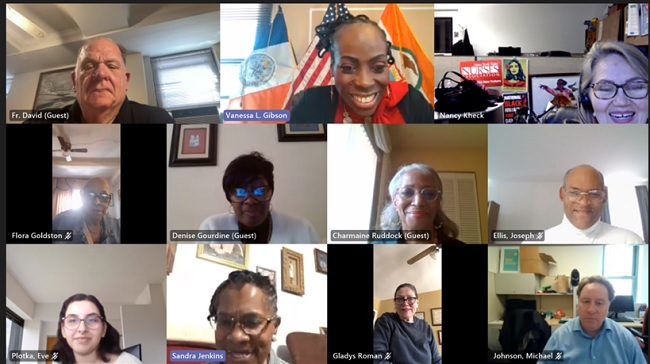
Members of the Bronx Health REACH Health Disparities Workgroup (HDWG) met with Bronx Borough President Vanessa L. Gibson.


In March, members of the Bronx Health REACH Health Disparities Workgroup (HDWG) met with Bronx Borough President Vanessa L. Gibson and Dr. Nancy Kheck, Director of Health and Human Services for the Bronx Borough President’s Office. The meeting was held to discuss the findings of the 2023 Robert Wood Johnson Foundation County Health Rankings report and the policy Asks of the HDWG. 

In January, during her State of the Bronx address, the Borough President indicated that improving the health of the Bronx was a priority. At the meeting with her, the group discussed with her how the recently announced work of her office fits into these Asks. A follow up meeting will be scheduled with the Borough President in the upcoming months.

#NOT62: The Campaign for a Healthy Bronx. Coalition of Bronx Organizations Continues It's Mission of Advocating for the Health of The Bronx Despite Long Standing Ranking as the Unhealthiest County in NY State


Members of the Bronx Health REACH Health Disparities Workgroup at our last in person rally before the COVID pandemic shut down holding a #Not62 rally in December 2019.

The Robert Wood Johnson Foundation (RWJF) released its 2023 County Health Rankings Report earlier this year, and we saw that some of the positive changes that happened from 2010 to 2020, namely, improvement in the quality of life and health behavior of residents have been reversed. Especially concerning is the noted worsening food environment (6.8% compared to 7.6% in 2022), food insecurity (20% compared to 16% in 2022) and an increase in children poverty (34% compared to 31% in 2022).

Earlier this month at our quarterly Coalition meeting, Bronx Health REACH welcomed researchers from the University of Wisconsin who are responsible for determining the county health rankings. They discussed the findings for the Bronx, to help us better understand why we continue to rank last and to offer some insight in what we should be addressing to improve our ranking.

Since 2015, The Institute for Family Health/Bronx Health REACH, Montefiore Health Systems, Bronx Neighborhood Health Action Center, the Office of the Bronx Borough President and others have served as the backbone organizations for a growing coalition of partners that are a part of #Not62: The Campaign for a Healthy Bronx. This #Not62 Steering Committee is dedicated to improving health outcomes and addressing longstanding health inequities in the borough. The Campaign, leveraging the power of community partnerships, contributed to improved health outcomes between 2016-2021, demonstrating the value of community investments to foster a healthier Bronx.

The #Not62 Coalition partners will be expanding to a larger group bringing in more experts from the Bronx as they move forward with a new five-year plan that provides a roadmap for recovery to help Bronx residents respond to the challenges, traumas, and health burdens they continue to face. The Campaign will tackle these challenges by connecting people, resources, and systems with public health partners to foster community wellbeing and a future Bronx no longer ranked last.


Thursday, March 12, 2020

Fresh Food, Fresh Attitude! Increasing Access to Healthy Grab-and-Go Items at Bronx Bodegas


William is the owner of Makey Deli, located at 2704 Third Avenue in the Bronx.

This post was written by Kelly Moltzen, Program Manager for Bronx Health REACH’s Creating Healthy Schools and Communities.

On average, Americans eat more than 3,400 mg. of sodium daily – more than double the American Heart Association’s recommended daily limit of 1,500 mg. 77% of the sodium that Americans consume comes from processed foods and food served in restaurants.

In the Bronx, items that people often buy at bodegas are processed foods high in sodium, including chips, deli meats, and cheese. Bronx Health REACH, Montfiore Medical Center and City Harvest are part of the Bronx Bodega Partners Workgroup, offering healthy food retail initiatives to encourage stores to stock healthier items, such as low-sodium deli meats and healthy snack alternatives. The Workgroup launched the Don’t Stress, Eat Fresh healthy bodega marketing campaign to increase awareness of these healthier options throughout the Bronx community.

Bronx Health REACH, with support from the American Heart Association’s NYC Community Impact Grant, is collaborating with the Bronx healthy food advocate, Shen’naque Sean Butler and his “FRESCH” campaign to expand the number of bodegas selling healthy grab-and-go items. To date, Sean has organized taste tests at bodegas, schools, and in the community, offering hummus, three-bean salad, a vegan salad, and pico de gallo. Future taste tests include cut vegetables with dip, fruit cups, and overnight oats. We hope the combination of taste tests and increased access to these healthy items for sale in the community, coupled with the Don’t Stress, Eat Fresh healthy bodega marketing campaign will offer Bronx residents new items they will get excited about and support their health!

Montefiore Medical Center is collaborating with the Jerome Gun Hill Business Improvement District (BID)  to support bodega owners selling healthy foods such as The Bronx Salad and other healthy grab-and-go items. By partnering with NYC Small Business Services, the Jerome Gun Hill BID offers bodegas compliance consultations, financial education, trainings, advertising and promotional support, and other business support resources.

City Harvest has established a relationship with Fairway to get healthy grab-and-go items sold in supermarkets and corner stores in the Bronx. After an initial pilot phase, the following seven Bronx stores are participating in the grab-and-go program:

1. Borinquen Supermarket, 436 Brook Avenue
2. Met Food Supermarket, 649 Jackson Avenue
3. Real Supermarket, 795 Prospect Avenue
4. Makey Deli, 2704 Third Avenue
5. D & D Deli, 100 West 168th Street
6. Moe’s Quick Deli, 469 Brook Avenue
7. Wanda’s Deli, 104 Elliot Place

Consuming less sodium and more fruits and vegetables – including the items promoted through the grab-and-go program – are part of the Dietary Approaches to Stop Hypertension (DASH) diet plan, and is an important step in reducing the risk of diet-related diseases such as hypertension and stroke.

For more information, contact Kelly Moltzen via email or call (212) 633-0800 x 1328.

Friday, February 28, 2020

Men’s Health Workshop Debuts at the Institute for Family Health Stevenson Family Health Center

Eight men attended the Men’s Health Workshop at the Institute for Family Health’s Stevenson Family Health Center. Joseph Ellis, author of this article, is fourth from the left.

This post was written by Joseph Ellis, a Community Health Worker at Bronx Health REACH.

As a Community Health Worker for Bronx Health REACH and the Men’s Department Coordinator for my church, Bronx Deliverance Center of Faith, I have been working and communicating with men in the community and the churches for several years. Our conversations have been on various subjects such as spiritual growth, finances, community involvement, and health.

I’ve noticed that when we begin to talk about our health, we come up with many reasons why we are not giving our health top priority in our life. For example, we work, we are tired when we get home, we have no desire, we are not interested in exercising because it takes too much time, we eat whatever our partner cooks, or we do not have time to go to the Doctor.

Normally men have a difficult time discussing issues concerning our health. Our perception of ourselves is often: whatever we face, we can handle. Irrespective of the challenge, men believe they are indestructible, and can address any issue on their own, even if it’s a health one. But this is not always the case.

Many of the men I have spoken with mentioned having struggles with health concerns like diabetes, being overweight and losing the weight, being stressed about work and providing for their families. As a Community Health Worker, I wanted to do something to address these concerns. If I could get them all together in a workshop and have their health concerns addressed by a doctor, maybe they would be more receptive to opening up about the challenges they have as men regarding being healthy.

With the help of Ms. Tabasa Ozawa, one of the interns at Bronx Health REACH, we created a Men’s Health survey that we distributed to men to get a broader idea of the other health topics they are concerned about. Using this survey, I was able to outreach to 160 men from different ethnicities and ages in the community, churches, and masjids. It took a couple of months to gather all this important information together.

From the information gathered, I organized a Men’s Health Workshop at the Institute for Family Health’s Stevenson Family Health Center in the Bronx. Dr. Eric Gayle, the NYC Regional Medical director for the Institute for Family Health, led this first Men’s Health Workshop on Saturday, January 18, 2020.


Dr. Eric Gayle led the workshop and answered questions about Men’s health.

Several health topics were chosen that we felt would encourage a dialogue among the men.
Those topics were:

a. Age Dependent Preventive Health
b. Health
c. Wellness
d. Interacting with your Primary Provider
e. Cancer Screenings


The interaction between the men and Dr. Gayle was dynamic. He talked to them and not at them. As they warmed up to him, the questions just kept coming. This workshop was designed to get the men to open up about their health concerns, and they did. Scheduled for two hours, the workshop easily went another half an hour.

Questions were addressed about diabetes, family history, discussing your health concerns with your doctor; (the doctors are here to help you but need you to communicate to them what is bothering you), sexual health, prostate growth and cancer, what are the options to combat these concerns and more.

The workshop hit home for the men and they wanted to know when we would be holding the next one. When the workshop ended, a couple of the men hugged Dr. Gayle and prayed for him. Wow! What a positive response to a dynamic workshop.

Attendees were encouraged to be proactive in managing their health.

As a Community Health Worker, I am encouraged that having these Men’s Health Workshops will be a tremendous help in assisting the men in our communities to take charge of their health and become more proactive. With the help of Dr. Gayle and other providers at the Institute for Family Health, we will continue to organize more workshops to provide a forum where men can have an open discussion about their health.


If you would like more information about the Men’s Health Workshop, contact Joseph Ellis at (212) 633-0800, ext. 1341.

Monday, January 13, 2020

Bronx Health REACH Meets with Senator Alessandra Biaggi


Left to right: Maxine Golub from the Institute for Family Health; New York State Senator Alessandra Biaggi; Kelly Moltzen and Moria Byrne-Zaaloff from Bronx Health REACH; Jacqueline Chiofalo from the Institute for Family Health.

On December 12th, Bronx Health REACH's Kelly Moltzen and Moria Byrne-Zaaloff from our Creating Healthy Schools and Communities program, along with Maxine Golub and Jacqueline Chiofalo from the Institute for Family Health met and spoke with State Senator Alessandra Biaggi. Kelly and Moria discussed the WELL Campaign (Wellness, Equity & Learning Legislation) which asks for a New York State model school wellness policy, and funding to go to the New York State Education Department for school districts to develop and implement wellness policies based on the model state wellness policy.

As a supporter of the WELL Campaign, she was surprised to learn that even though other states have school wellness statutes in place, New York does not. Senator Biaggi is also a sponsor of the New York State Health Act [A.5248, S.3577], and was pleased to know that Institute for Family Health and Bronx Health REACH staff testified at hearings in the Bronx and in Kingston, NY, in support of the Act.

Saturday, January 11, 2020

Bronx Health REACH Testifies in Support of New York Health Act


On October 23rd, Bronx Health REACH's Charmaine Ruddock provided testimony in support of the New York Health Act at the public hearing held in the Bronx. Charmaine was one of sixty individuals providing testimony in support of the New York Health Act. Charmaine took questions from State Senator Alessandra Biaggi and Assemblymember Kevin M. Byrne.

The joint New York State Senate and Assembly public hearing held at the Bronx Library Center was part of a series of hearings that provided input from New York State residents and organizations. If passed, the New York Health Act would provide comprehensive single-payer health coverage for all New York State residents, removing out of network fees, deductibles and copays that are charged to patients from traditional health insurance coverage.

See: https://www.nysenate.gov/calendar/public-hearings/november-25-2019/joint-public-hearing-new-york-health-act.

You can view Charmaine testifying here.

Tuesday, October 22, 2019

Year Two of Service Begins With A Summer Harvest and Cafeteria Improvement Plans

Adrianna gave a presentation at the FoodCorps National Orientation in Portland, Oregon. 

This post is written by Adriana Perez, our FoodCorps member who partners with the Sheridan Academy for Young Leaders (PS457)/the Family School (PS443). Adriana is dedicating a second year of service to engaging students and teachers in creating a school wide culture of health through experiential learning in their school garden, cafeteria and classroom. 


I recently returned from FoodCorp’s National Orientation in Portland, Oregon, where I was able to take a deep dive into planning for my second year of service at the Sheridan Academy for Young Leaders (PS457)/The Family School (PS443) in the Bronx.

During the week-long orientation, I brainstormed with FoodCorps staff and Service Members from across the country, led a session on how to overcome challenging work relationships, renewed my energy and ambitions for the coming school year through project management workshops, and formed a new appreciation for all the work that I accomplished last year.

 This year, I will not only be working at the two schools, but I will be returning to school myself. I will be entering a Master’s program at New York University in Food Studies with a concentration in Food Policy and Advocacy. My courses will help me expand my knowledge on food system issues, increase my understanding of how food and cultures intersect and how to effectively advocate for food system change. My FoodCorps experience at PS457 and PS443 last year has deepened and solidified my belief that not only should healthy, sustainable food be available to every community, but that every community should have the opportunity to learn more about where food comes from, how to prepare it, and how to have a balanced relationship with food. Through my studies at NYU, I will have the knowledge to educate my school community in local food systems and policy, and train them to be school wellness champions.


This year, I have decided to focus on three areas of technical assistance:  garden program development, cafeteria renovation and professional development for teachers. Last year, I worked with the Wellness Council, students and teachers at PS457 and PS443 to rebuild the schools’ garden spaces. I learned how to navigate scheduling conflicts for garden classes and garden management support from students, staff and parents. This year, teachers will be able to schedule their classes on a regular basis to visit the gardens. Garden clubs can help plant, maintain and harvest gardens on their own school properties as well as the community garden, a garden managed by both schools. Once the vegetables and herbs are ready to harvest, parents will be able to pick up or harvest vegetables during dismissal.


Since summer harvesting was so successful at PS443/PS457, Adriana invited parents to pick up seasonal produce at dismissal during the first week of school. What a healthy way to start the new school year!


As my primary responsibility is to work at PS 457, the teachers will not only receive teaching assistance during classes in the garden, but I will also provide support in creating lessons and strategies so that food education can be incorporated into common core standards for every grade. My objective is to equip teachers with tools that will encourage healthy eating for their students while introducing new subject-specific concepts and reinforcing previous lessons.

Finally, my biggest ambition for the year is to work with the Wellness Councils, which now exist as two separate councils, to undertake cafeteria improvements. These changes can be as simple as streamlining the traffic flow on the lunch line or as complex as providing a public announcement system or purchasing new tables for the cafeteria. The Wellness Councils will help me create excitement and strengthen support and engagement from the administration and cafeteria staff as well as aides and parent volunteers managing students during lunch. My hope is that through these changes, all students will be able to have a more enjoyable cafeteria experience through creating excitement around the school food menu in school and greater efficiency in the cafeteria.

This year will be challenging, but I plan to rise to the occasion and hit the ground running with these goals clearly set out before me. I look forward to working with the teachers, meeting new staff, and collaborating more closely with the principles of PS457 and PS443, Ms. Febus and Ms. Penn.

Monday, September 30, 2019

Loyce Godfrey's Commitment to Health, Nutrition, and Faith Based Organizations in the Bronx


Bronx Health REACH (BHR) faith and nutrition consultant, Loyce Godfrey, has been working with faith-based participants in the Healthy Children, Healthy Families program over the past two years. The Health and Human Services, Office of Minority Health funded initiative aims to reduce childhood obesity. Loyce developed the curriculum and trains faith-based leaders to teach the nutrition program. She has a long history working with Bronx Health REACH as a faith-based community leader and creator of the Fine, Fit and Fabulous program, one of our most successful health promotion programs. BHR’s Healthy Children, Healthy Families Program Manager, Emily Oppenheimer spoke with Loyce about her commitment to health, nutrition, and faith based organizations in the Bronx.

How did you get your start in health and nutrition?

I attended Tuskegee University and studied nutrition. It took me a while to graduate from college because I got involved in the civil rights movement. Before graduation, I was hired for a job in New York City. I started my first job as an assistant manager at Chock Full o’ Nuts. I was the first African American woman hired there in a management position. At the time there were no explicit policies addressing sexual harassment in the workplace when I was sexually harassed by some of the male colleagues there. It became uncomfortable for me to work there, so I left the company.

From there, I got my start with community-based jobs. I went into child daycare dietetics. I even owned my own daycare center for a while. Then I got involved with seniors. Mid-Bronx Senior Citizens Council decided they wanted to start a catering service, so I worked with them to get that up and going. 

I worked on opening the first SAGE Center in New York. (SAGE Center is the first full-time LGBT senior center in the country that offers services and programs related to arts and culture, fitness, food and nutrition, and health and wellness). I wrote operating nutrition services procedures, led trainings, secured permits, found a caterer to comply with requirements for meal serving, established record keeping, etc. I have also worked with City Meals on Wheels creating a healthy heart kitchen for seniors and have just completed a project for seniors who may have oral health challenges.

At one point you co-owned a store that featured arts, crafts and clothing imported from Africa.

Yes, I was a partner. It was a very healing, holistic experience. I have always liked to explore and visit faraway places. It may have come from growing up in a small town. I was interested in other parts of the world where black people lived. I liked some of the cultural aspects that were so authentic, like the wood-carved furniture. There were lots of cultural activities in NYC, and through that network I met a woman from West Africa who needed help with her store.


How did you connect with Bronx Health REACH?

Joyce Davis (one of the early leaders of BHR) and I worked together at Mid-Bronx Senior Citizens Council. During one of our conversations, I told her about a new ministry I had started at my church around healthy topics and nutrition. She told me that she was involved in a similar project with churches and BHR. She invited me to attend a BHR meeting. At the meeting church leaders were sharing updates on their work. When I spoke about what I was doing, Charmaine (Charmaine Ruddock, Project Director of BHR) said, “That’s exactly what we are trying to do!”

For me, this was my first time hearing about government funding opportunities for these projects. I knew health was a major concern in the Bronx so I would share my work at these meetings. I began consulting with BHR by providing workshops and assistance. I discovered that people who attended my church meetings would go eat at Popeyes afterwards. That felt so disconnected from the program I was leading with them. I bet that most of the women who attended the meeting had diabetes, heart disease or some other chronic disease. I was very concerned, so I thought, how could I get my point across so that those attending would no longer go to Popeyes afterwards? How could I combine the faith-based piece with the health behavior to change motivations? How could we align these two key principles? This led me to work on Fine, Fit and Fabulous.


What is a heritage food?

All of the heritage foods are real foods. All come from plants, from the ground. None of them were processed. After being brought to this country, many of those foods are still used in their original natural form.


The aim of our Healthy Children, Healthy Families program is to get families to eat more nutritious foods. What kinds of changes have you seen so far?

One of the barriers to eating healthier is the disconnect people have between real foods/heritage foods and processed junk foods. We are looking to show Bronx families that food, in its natural form, has not changed over the years. It is still the best nourishment for them. These real foods were so important for many generations. These foods sustain people and promote health. The goal is to get people to eat more real, healthy foods. For the families that have participated in the Healthy Children, Healthy Families programs, we are seeing more interest in eating vegetables and fruits. I am optimistic about seeing more of these positive changes. The excitement, cooperation, and passion of the churches is inspiring. Helping these churches to keep that energy alive after the program ends is so important and I think we can do it. For example, one of our church partners has a garden and I see that as a way for them to continue this work to grow and eat God’s real foods.

Tuesday, September 10, 2019

Helping Bronx Seniors Eat Healthier through Healthy Food Demonstrations


This post was written by Olivia Wurgaft, an intern at Bronx Health REACH and student attending Washington University.

As a Global Health major at Washington University, I would like to pursue a career in public health after I graduate. It is one of the reasons I was so happy that, as part of my internship at Bronx Health REACH, I got to work on their Food Service Guidelines initiative with meal serving sites in the Bronx. Specifically, I had the privilege of leading two healthy food demonstrations.

During the month of June, Bronx Health REACH held healthy food demonstrations at the Presbyterian Senior Services Parkside (PSS Parkside) and Presbyterian Senior Services Jackson (PSS Jackson) sites in the Bronx. PSS is a nonprofit agency with nine community centers that strive to strengthen the capacity of older New Yorkers, their families, and communities to thrive. PSS Parkside and Jackson clients receive meals, exercise classes, technology training, group trips, and a multitude of other services. These food demonstrations are part of Bronx Health REACH’s efforts to help sites serve healthier meals to their clients.


Earlier this year, Bronx Health REACH collaborated with Lenox Hill Teaching Kitchen to provide trainings for PSS Jackson and PSS Parkside staff. Lenox Hill Teaching Kitchen designed a daylong food business training to help nonprofit organizations prepare and serve institutional meals that increase fresh, healthy, and local foods to support their clients’ health. The outcome of this training was to gain a better understanding of how to serve meals with more scratch cooking with fresh fruits, vegetables, and whole grains, and less sugar, fat, and salt. At the end of the training the goal of the kitchen staff from PSS Jackson and PSS Parkside is to increase their use of fresh, healthy and local food.


 In addition to the training, Bronx Health REACH has been providing PSS Jackson and PSS Parkside with technical support to achieve these goals including food demonstrations. These demonstrations are to introduce healthier food to clients through tastings, give them a say in what appears on their menu, and show them that healthy food can be tasty and inexpensive. Both sites chose “Olga’s Bulgur with Chicken” as the recipe for their demonstration because it includes more vegetables and whole grains and less meat.

Before the demonstration, I went to a supermarket close to the site, to make sure the ingredients were easily available for clients to make the dish themselves. I also made sure to price out the recipe to make sure it was affordable.

At both sites I arrived around lunchtime to prepare for the demonstration. While I was chopping and measuring out the carrots, celery, peas, and garlic, some clients came up to ask what I was doing, which told me they were interested in learning about what they were going to eat. Some were also apprehensive of trying something new, but promised they would keep an open mind. I started each food demonstration with a discussion about the nutritional benefits of each ingredient. I emphasized how the fiber in the bulgur wheat improves digestion, the vitamin A in carrots improves eyesight, and how low sodium soy sauce reduces salt intake, which is particularly beneficial for people with high blood pressure or diabetes.


I sautĂ©ed the chicken, added the vegetables and mixed them in with the bulgur wheat, explaining the process as I went along. Before adding it to the pan, I brought the pot of bulgur wheat around to each participant, explaining that it can be used similarly to rice and showing them what it looked like. When the dish was finished, I distributed samples for everyone to try. Participants filled out surveys about the recipe and the demonstration. At PSS Parkside, the responses were overwhelmingly positive. Most of the participants enjoyed the recipe and wanted it on the menu. One client said that the “dish was filling, [and had] nice and crunchy vegetables.” Another loved how it was “economic and easy to make at home.”

 At PSS Jackson, the participants were more wary to try a new dish. However, after watching the demonstration and becoming more comfortable with the ingredients, not only did they try it, but they really liked it. One client explained, “I liked this activity because it allowed me to try new and interesting foods that I could possibly have more of in the future.” This comment reaffirmed for me the benefits of food demonstrations and similar programs that expose participants to healthy and tasty options. Without this demonstration, many clients would never have tried bulgur, and now, after liking it, wanted it in their meals. After these successful food demonstrations, I am both excited and hopeful that PSS Parkside and PSS Jackson can easily add healthy, tasty, and economical recipes to their menus to increase the health and well-being of their clients.


This interactive and fun activity was extremely useful in keeping clients educated and involved in menu planning at their sites. Many told me that they wanted to eat healthier, but did not have access to the right ingredients or the knowledge of how to do it in an inexpensive way. Through the food demonstration, they were able to learn about this recipe that will help them do just that. From this experience, I learned that sometimes all it takes to open people up to new ideas, such as eating healthier meals, is the opportunity for them to try it. My internship enabled me to help Bronx Health REACH provide this opportunity.  I believe both sites will have an easier transition to a healthier menu.

Welcome!

Welcome to the Bronx Health REACH blog! If you're new to Bronx Health REACH, check out our website to learn more about us. You can also friend us on Facebook or follow us on Twitter!