Saturday, August 24, 2024

Health Disparities Work Group #Not62 Campaign


To continue to create awareness around The Bronx being designated as the unhealthiest county in New York State, the Bronx Health REACH Health Disparities Workgroup appeared on Stay Alive with Church Alive.


The Robert Wood Johnson Foundation (RWJF) released the 2024 County Health Rankings & Roadmaps. The report shows there are places where the Bronx has improved: Physical inactivity in the Bronx decreased; the percent of those uninsured decreased and unemployment had a notable improvement from 13.6% in 2023 to 7.8% in the 2024 data. However, for fifteen years in a row, the Bronx remains the least healthy of New York state counties.

In response to the report, Bronx Health REACH designated April as #Not62 month. Our Health Disparities Workgroup prepared information sheets for community and faith based organizations to distribute and post prominently in their organizations. In addition, the faith based organizations were encouraged to use their platform to share information about #Not62 during their day of worship throughout the month. 

The Bronx Health REACH Health Disparities Workgroup also appeared on Stay Alive with Church Alive, hosted by Bishop Timothy Birkett. Appearing on the show were Bronx Health REACH Project Director Charmaine Ruddock, Rev. Wendy Kelly Carter from Beulah Baptist Church, Pastor David Powers from Church of St. Helena's Roman Catholic Church in the Bronx and Sandra Jenkins from Church of God of Prophecy, Bronx NY.

The Health Disparities Workgroup spoke about creating awareness around #Not62 – The Campaign for A Healthy Bronx through townhalls, public rallies, and social media. They also spoke of the set of Policy Asks they have created focusing on Health, Housing and Economic Development and encouraging policy makers, elected officials and community leaders to support implementing these Asks through public budget allocations and policies at the City, State and Federal levels.

There have been meetings with elected officials including staffers of Bronx Congressional members: Congressman Ritchie Torres, Congressman Jamaal Bowman, Congresswoman Alexandria Ocasio-Cortez and Senator Chuck Schumer. During these visits, BHR advocated for the #Not62 campaign, and shared the policy Asks and recommended actions. These visits continue the HDWG's strategy of engaging with and educating elected officials with the goal of having policy and system changes to improve the health status of Bronx residents. We had met in the past with Mayor Bill de Blasio when he was in office, and last year with Bronx Borough President Vanessa L. Gibson sharing data from the Robert Wood Johnson Foundation County Health Rankings Report and updating her on our Asks.

Click here to watch video of the HDWG on Stay Alive with Church Alive


Boogie on the Boulevard Returns on Saturday, August 24th


After a four year hiatus, Boogie on the Boulevard returns on Saturday, August 24th.


After a four year hiatus, Boogie on the Boulevard returns Saturday, August 24th from 7 a.m. to 3 p.m.  This year’s Boogie on the Boulevard will differ in one significant way from previous ones as it will now be part of the New York City Department of Transportation's Summer Streets. The event will be along the center lanes of the Grand Concourse, from East Tremont Avenue to 182nd Street which will be closed to cars and open to a world of fun, providing residents an open space to run, bike, walk and participate in music, art, dance and fitness programs. Other offerings will include yoga, Tai Chi, bicycle safety, live dancing and music performances.  

Thursday, February 1, 2024

Food as Medicine: A “Prescription” for Fresh Fruit and Vegetables


This article was written by Kenny Escobar, Nutrition & Physical Activity Coordinator, Jamila Outlar, Produce Prescription Coordinator, and Intern Stephanie Garcia.

In the winter of 2023, Bronx Health REACH and Corbin Hill Food Project Inc. (CHFP) launched the Food as Medicine Produce Prescription Program (FAM) for patients at three Bronx-based Institute for Family Health (IFH) centers to promote the consumption of healthy food.

The FAM project is funded by the Gus Schumacher Nutrition Incentive Program (GusNIP) grant from the National Institute of Food and Agriculture (NIFA) of the USDA.  Project participants must be an IFH patient over 18 years of age and screen positive for food insecurity. Once enrolled, participants receive a box of high quality, fresh local fruits and vegetables on a bi-weekly basis for a minimum of six months. The average price for the box of produce is roughly $35 but through FAM the cost to patients is only $2.50. The participants can pay with SNAP, cash, debit, or credit card. Participants who have SNAP can also pay with Health Bucks.

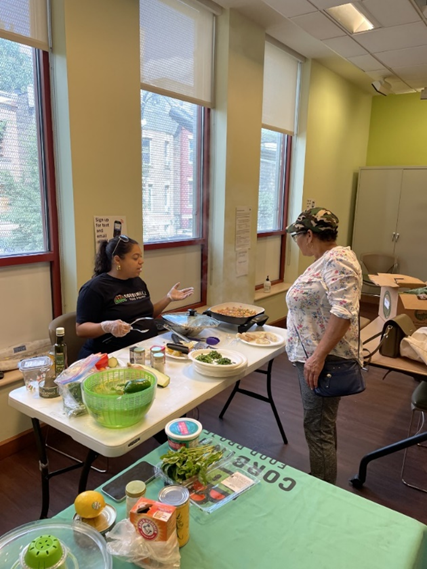
The FAM project also provides participants with recipes at each distribution in order to encourage the eating of fruits and vegetables. These recipes include creative and helpful ways to use the produce from that week’s distribution. Food demonstrations accompany the distribution of the recipes at least once a month at each health center introducing participants to  fruits and vegetables they may not have known or previously eaten. 


Chef Yadi leading a food demonstration. 

Bronx native Chef Yadira Garcia, also known as, the “Happy Healthy Latina” or Chef Yadi, is the chef enthusiastically creating delicious and nutritious dishes for patients to try. She makes sure that patients are educated on the multiple ways to prepare the different produce and is always open to answering any questions that the participants may have. 


As of February 2024, when enrollment ended, 374 patients were enrolled in the program and 130 have completed their 6-month commitment. We will conduct a program evaluation to assess patients’ overall opinions and feedback of the program to determine the effectiveness of this intervention and the impact it has had on the participants. To date feedback from some participants indicate that the program, for them, is a resounding success. An Urban Horizons patient shared that they are “very happy as a lot of us need this program, we get healthy food and we need this in the neighborhood. You’re doing a very good thing for us." A Stevenson patient said she “enjoys this program so much as I am learning how to cook and eat different things.” A patient from Walton stated, “by receiving these produce box two times a month, I am able to eat healthier which is contributing to my weight loss.”


Wednesday, November 1, 2023

The Boogie Down Walking Club: Implementing Walking Programs as a Sustainable Form of Physical Activity


Members of Grand Concourse Seventh Day Adventist Church Walking Club.


This post was written by Immaculada Moronta.


With the high rates of obesity and overweight in many South Bronx neighborhoods, a low impact activity such as walking provides a great opportunity for residents to get physical activity. But being able to safely engage in physical activity in many Bronx neighborhoods is no simple walk in the park. Many areas of the Bronx are densely populated urban areas where open, green spaces are limited, and many public areas have conditions that discourage residents to get out and walk. There are unsafe walking conditions such as unpaved and uneven or dirty sidewalks, construction activities, unsafe crosswalks, busy vehicular traffic and areas with criminal activity. 


Bronx Health REACH, in collaboration with Equity Design, an organization that uses physical activity to motivate and transform the lives of youth, adults and communities, launched a walking program, with seven participating faithbased organizations. Bible Church of Christ, Cathedral at Greater Faith in the Bronx, Church Alive Community Church, Grand Concourse Seventh Day Adventist, Every Day is a Miracle, New Life Rehoboth Church and St. Jerome Church completed the program with 80 participants in the summer of 2023. From June to September, the partners collectively walked 128.23 miles/296,801 steps.  


Members of Cathedral at Greater Faith in the Bronx Walking Club.


The walks not only provide a low-impact physical activity and social connectedness, but also create a safe environment for the community of walkers by activating spaces deemed unsafe or unfit for walking, and to help narrow existing health inequity gaps that remain for Black and Latino residents in many Bronx communities.


The partners designed their walking routes with technical assistance provided by Equity Design and tailored their goals to the needs and capacity of the people leading the clubs and the participants. For example, the goal for one of the walking clubs included a one-mile walk in 20 to 30 minutes, while another it was 1,000 steps per participant. The walking clubs also set a collective goal of completing one million steps. Prospective members of a walking club completed a survey to determine what days and times they preferred to walk, how many times a week to meet and if they had any health issues that would impact their ability to walk.  Each walking club partner completed a walking assessment of their proposed walking route to determine walkability, taking into account: sidewalk conditions, pedestrian traffic, the number of trees and seating per block along a route, cleanliness of routes, vehicular traffic and accessibility to public transportation. 


Members of Christian Bible Temple Walking Club.


A major success of this project was that each walking club created their own timeline and action steps to ensure the sustainability of their program. A tool developed for the walking clubs was a walking course map highlighting and identifying the degree of ease vs. difficulty for each route i.e. steep places vs. flat surfaces and distance. The tools could be accessed through Google Earth on users’ smartphones. A captain and co-captain were selected by the members of each walking group. To promote their walking club and church affiliation some walking clubs printed their own t-shirts for each participant to wear and provided them with visors, water bottles, pedometers, captain t-shirts, and whistles. 


The impact of this initiative can be seen at both the community and individual level. One notable example of community level impact is Bible Church of Christ. During their environmental assessment of their proposed walking route, members observed that substance abusers and homeless people occupied an open space along their walking route. Instead of finding an alternate route, they invited all those that were there to join them. Several community members subsequently joined them in their weekly walks. As a result, those residents who joined, are helping the walking club create a safer space. Individual walking club members have been touting the benefits from walking. Christian Bible Temple completed a community clean-up day surrounding the blocks around the church that were was part of their walking route. Equity Design connected them with the New York City Department of Sanitation and received tools to continue with the cleanup. On the individual level, one woman, a senior citizen, had been using a walker when she started walking with the walking club, and now she no longer needs to use a walker.


The faith-based walking clubs not only provide physical activity but social connectedness as well for participants, which many sought following the devastating isolation brought on by the COVID-19 pandemic. The level of commitment from the walking clubs is powerful. Many times over these walking clubs have brought people together with the goal of making healthier versions of themselves. Our walking clubs always find a way to bring out the best in each of their members with the goal of getting physically active in the Boogie Down Bronx!

Welcome!

Welcome to the Bronx Health REACH blog! If you're new to Bronx Health REACH, check out our website to learn more about us. You can also friend us on Facebook or follow us on Twitter!